by Sarah Kain
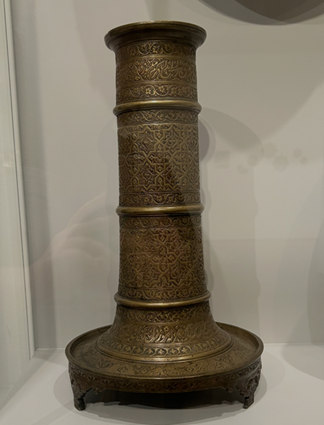
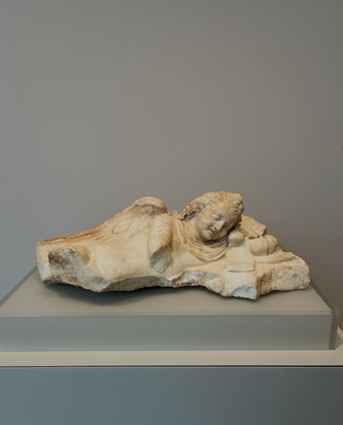
Standing amidst a throng of happy couples on Valentine’s Day at the Harvard Art Museums, I listened to our student guide Diana read an English translation of the inscription on a 16th century Persian torch stand: Sometimes my soul burns with love of the beauties,/ Sometimes my heart bleeds./ Every moment, passion burns me with a new brand./ Like the moth, I seek a candle./ If I advance I burn my wing./ “What does this tell us about love?” Diana asked our group. Some of us thought the poem might be a warning that love is dangerous and will harm us if we get too close. Others suggested the burning candle represents an eternal, religious kind of love that calls for reverence and respect. Diana shared that she chose this piece because for her it embodies ‘agape,’ a concept she learned about in her philosophy course. In contrast to the first stop on our tour, a small sculpture of a sleeping Cupid, agape describes a selfless, unconditional love, rather than a sensual, erotic love, otherwise known as ‘eros.’ “I think,” Diana continued, “that the main takeaway is that love can take on many different forms. What does it mean to you to love somebody?”
I pondered this question as I wandered through the rest of the massive space after the tour
concluded. The Harvard Art Museums (“the Museums”) actually comprise three distinct museums in one building – the Fogg Museum (1895), the Busch-Reisinger Museum (1903), and the Arthur M. Sackler Museum (1985) – each with its own collection, history, mission, and identity. In addition to beautiful galleries, the Museums also maintain four research centers and countless partnership programs with Harvard University to facilitate learning opportunities for students. Embracing a role as both community resource and global institution, the Museums “welcome visitors from around the corner and around the world.”
“The Moods of Love” tour I took with Diana is one of many offered through the Museums’ Student Guide program. Through this program, the Museums prepare students to develop original, research-based Spotlight Tours of the collections. A typical Spotlight Tour occurs on the weekend, lasts around fifty minutes, and comprises three objects and/or stops along the way. Student guides are able to select not only the themes of their tours, but also the objects to highlight and the content to deliver based on what interests them. As a philosophy student, Diana’s tours often center around big, existential questions, like love, loss, and injury and repair. The program does not require student guides to have any background in art history or museums as all participants receive training before stepping into their roles. In fact, the current cohort of student guides represents a wide variety of disciplines, including astrophysics, mathematics, computer science, history, and literature. In addition to developing Spotlight Tours, student guides also support the Museums’ U.S. Citizenship Course and create content for social media, including on Instagram (@harvardarthappens) and YouTube (@harvartmuseums). The Ho Family Student Guide Fund generously provides all student guides with financial compensation and enables visitors to enjoy Spotlight Tours free of charge.
In terms of outreach, the Student Guide program serves dual purposes. On the one hand, such a program allows the Museums to engage Harvard students in their work and counter the narrative that their resources are only for those studying art and art history. According to the website, the Museums “encourage all Harvard students—of all backgrounds and levels of museum experience—to consider [the] building and collections as a place to explore their identities, creativity, academic perspectives, and life’s big questions.” Hiring student guides from a range of academic programs signals to other students that the Museums have something to offer them, intellectually and also for enjoyment. Additionally, for many students who may feel uncomfortable in a cultural heritage institution like the Museums, having a familiar face and/or peer guide them through the galleries can decrease these invisible social barriers to entry. Finally, student guides are simply an excellent way to spread word of the Museums’ events and programs around campus. As an undergraduate, I always wanted to support my friends in their campus endeavors – especially if I did not have to spend any money to do so.
On the other hand, the student guide program offers the Museums an opportunity to cultivate the trust and respect of the local community, of which students are but one part. Similar academic institutions often invest time, money, and energy in developing highlight tours that focus on the most well-known or canonical objects in their collections. These tours typically present a narrow or hegemonic view of cultural heritage. In comparison, the Museums’ student-led Spotlight Tours not only provide more diverse samplings of the collections, but also present a broader range of perspectives drawn from students’ academic interests and personal histories. Further, the Museums train student guides to stimulate dialogue during Spotlight Tours. A student guide’s role is not simply to deliver content, but to facilitate information sharing between visitors. For example, Diana is not an expert on religion in the Middle East, but because she asked us good questions about the torch stand, another visitor from that cultural background was able to fill in some knowledge gaps for our group. In inviting more voices to join the conversation, the Museums are making a strong effort to connect with members of their local community, particularly those who similar institutions have not traditionally prioritized.
However, as I stood in the Arthur M. Sackler Museum with Diana, I was reminded of the structural issues inherent to many academic institutions that prevent them from becoming the community resources they strive to be. For example, when one member of our tour asked Diana how the Museums came into possession of the Sleeping Cupid (Eros) sculpture, Diana had to address its fraught provenance, dousing the energetic mood of the tour with one of slight discomfort. In this moment, it became apparent that the Museums need to engage in further reparative work to address these difficult legacies before all community members feel welcome.
Nevertheless, the Harvard Art Museums have certainly connected with the student population at Harvard and beyond in Boston. Diana spoke highly of the Student Guide program and the other student-focused programs at the Museums, and students made up a high percentage of our tour group. Though the Museums may still be finding their footing as both community resource and global institution, the Student Guide program serves as one model for successful, local outreach.
Further Reading:
Spotlight Tour: The Moods of Love, with Diana Ochoa-Chavez ’26